Development: 15 October 2026 · Written: 16 October 2026 · Revised: 22 October 2026
I wanted to make an app other people could use. I was curious whether I could earn some money from it, too. The trouble was, I hadn't decided what to build. I didn't really know what Apps in Toss was, either.
So I asked AI to explain Apps in Toss and what I could build for it.
Finding out about Apps in Toss
I'd already made a café training game and a photo map as HTML files. This time, I wanted to try making an app that would run inside Toss.
I learned that people could open apps published through Apps in Toss inside Toss, a Korean financial app. The guides I read also explained how to add paid features and ads.
I sent AI the developer guide and asked for ideas I could start small with. Among the suggestions, I picked a temperament test, something I'd long been interested in. I called it Ireonna (이런나).
I wanted to include something to do after reading the test result. I thought about being asked to take on extra work: plenty to say in my head, but all that comes out is, “Oh. Sure…” It might be useful to learn about my temperament and draft what I wanted to say in situations like that.
Sending a plan to Codex
On 15 October, I wrote down what I wanted and gave the document to Codex. A short version of my request was:
Please build an app for Apps in Toss based on this planning document.
The first screen had two buttons: take a 40-question test or make a conversation card. Someone who just wanted help putting a request into words could skip the test. Forty questions would be a lot to ask before letting them do that.
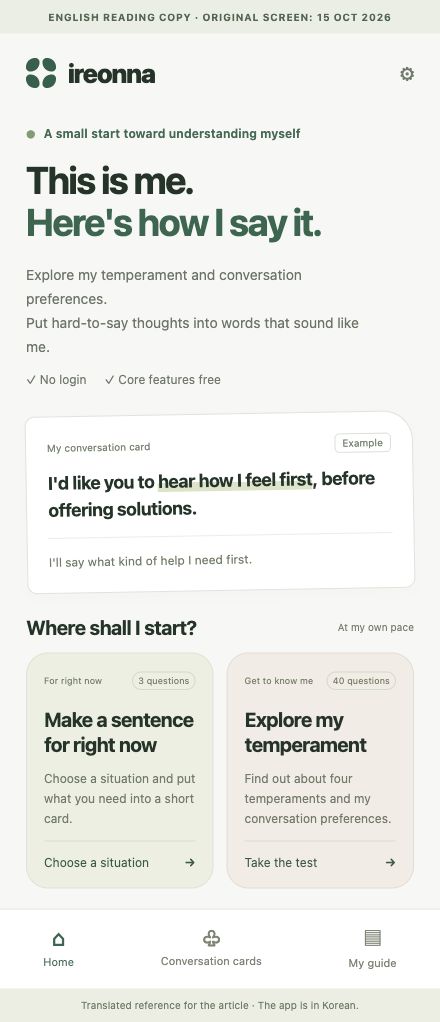
English reading copy of the Korean screen captured on 15 October 2026. The original placed the two starting buttons side by side. This is a translated reference for the post, not an English version of the app.
Making a card and trying the test
I opened the app in a browser, chose the extra-work situation, and made a card. Below the request to the other person was What I'll do, too. If I couldn't answer straight away, for instance, I could say when I'd get back to them.
Without that, the card might just become a list of things I wanted the other person to do. Including something I'd do myself seemed like a good idea.
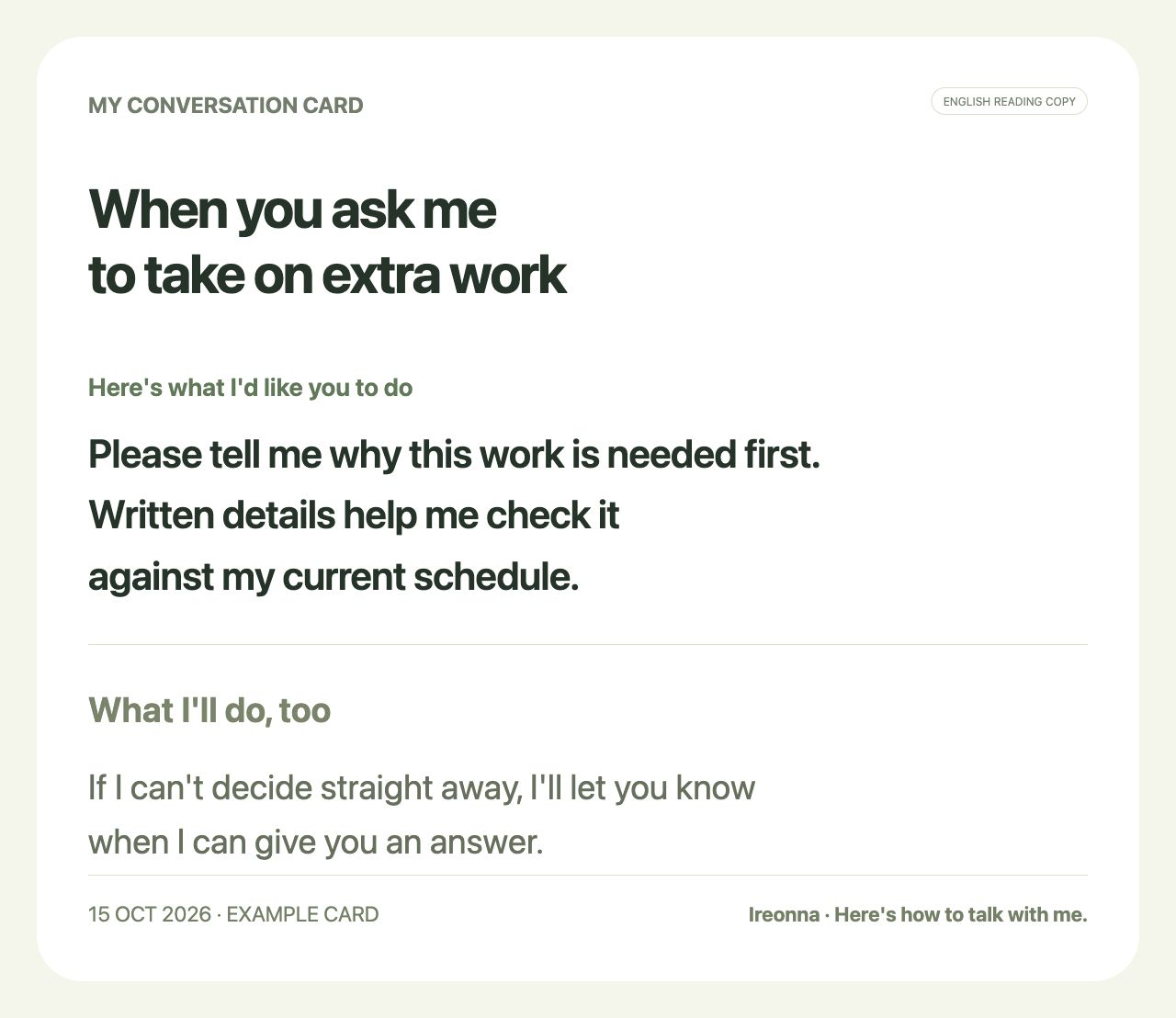
English reading copy of a PNG exported by the Korean app on 15 October 2026 using example answers. This is not a real user's conversation or testimonial.
The labels on the test results bothered me a little: 표현형, 추진형, 성찰형, 안정형—roughly Expressive, Driven, Reflective, and Steady. They made sense if you already knew the descriptions, but I wasn't sure someone seeing just the names would know what they meant.
I asked AI to add the traditional names, such as sanguine and choleric, alongside them, with everyday examples. I hadn't thought much about how to explain the names when I wrote the plan. Reading the results made me want to revise that part, too.
That was how I made the first screens. The app is still in development. Testing and review inside Toss are still ahead, and I have yet to find out whether it can earn money. In the next post, I'll write about revising the names and descriptions.
Next · Apps in Toss 02: Ireonna’s descriptions and conversation cards